As a digital programme in collaboration with the British Council at the 61st Venice Biennale, iniva is pleased to announce the third edition of the Post-National Digital Pavilion, titled The Message Is in the Pattern.
This programme is developed in response to Lubaina Himid’s British Pavilion commission Predicting History: Testing Translation, which draws on her long-standing methodologies of making histories visible, working collaboratively, and attending to the political significance of everyday materials and gestures. The programme foregrounds lived practices and relational forms of making that emerge through sustained engagement with communities.
Three invited artists, Anya Paintsil (UK), Rajyashri Goody (India), and Rose Afefé (Brazil) are supported to work within their local contexts, exploring the intersection of community engagement, cultural translation, and the relationship between artistic and social practice.
In addition, the programme will commission four writers through an international open call, to respond critically and creatively to the digital works. These texts will be brought together in a digital publication that extends the life of the programme and situates the commissions within wider artistic, social, and political conversations.
This edition of the Post-National Digital Pavilion follows DRIFT (2022) and Unseen Guests (2024), continuing iniva’s commitment to building transnational and research-led public programmes, making art from a global perspective accessible to everyone.
The Message Is in the Pattern is curated by Beatriz Lobo with programme support by Vasita (Pleng) Jirathiyut and supported by the British Council.
Graphic design by Jeffrey Choy, with art direction by Charlotte Mui.
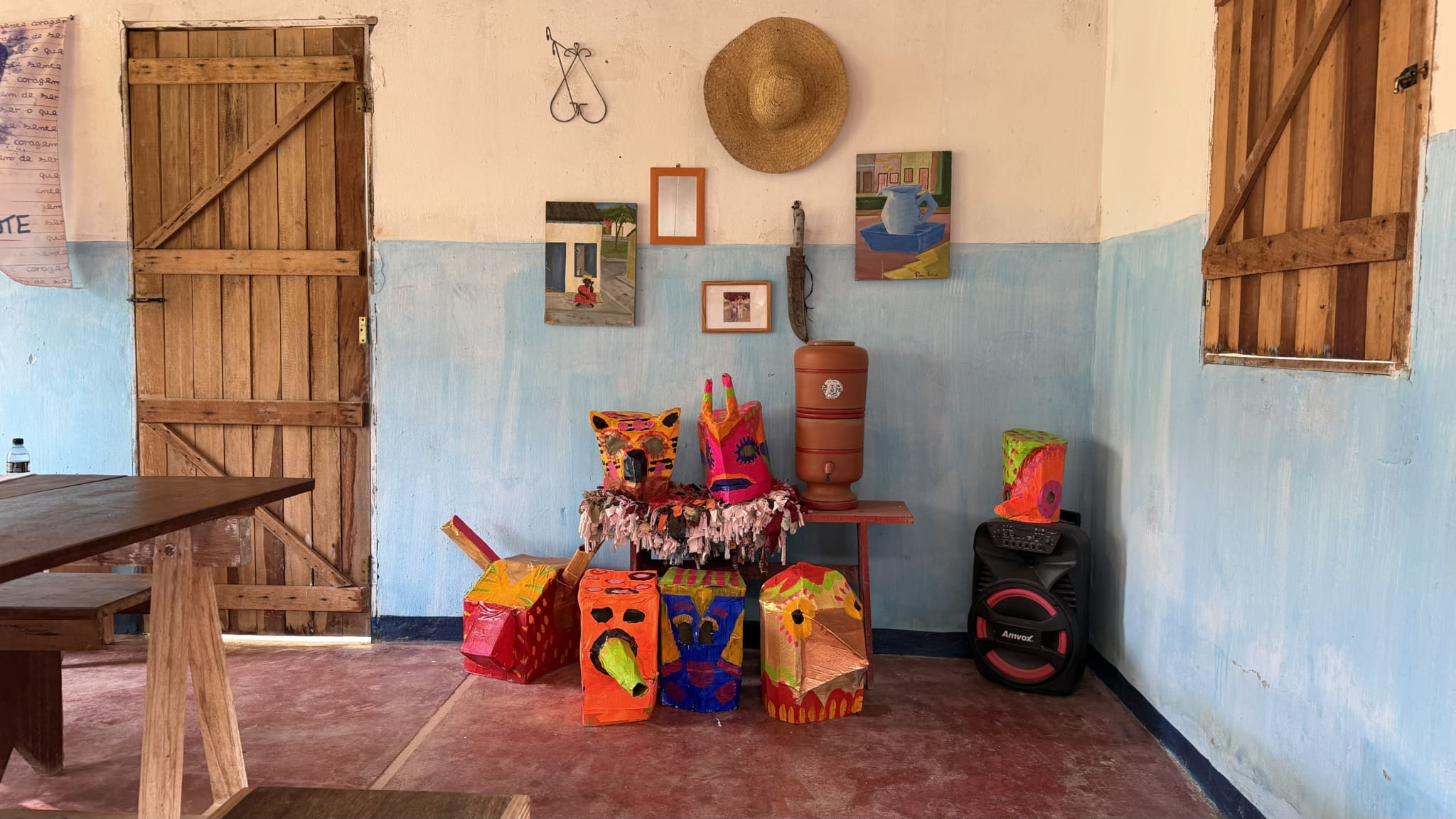
Documentation by Rose Afefé
The fabric pairings are made from several canvases seemingly but not interchangeable. The message is in the pattern. Pattern and colour are not random elements nor are they put down for decorative play. They are a new way of re-writing untold tales. Their language is more akin to the call of birds or the growth and blossoming of flowers; meaningful if you speak the tongue.
Lubaina Himid, Revenge, 1992
To begin here is to accept that meaning does not precede its form. It is made in and through it: through arrangement, repetition, and the kinds of relations that cannot be reduced to a single narrative. In Lubaina Himid’s work, pattern operates as both method and language, as a system through which untold stories are assembled, repeated, and made visible. It’s a structure of thinking, epistemological, even when it resists translation.
The Message Is in the Pattern takes shape within this proposition as a way of working across different registers at once: material, social, spatial, environmental, historical. Conceived as a Post-National Digital Pavilion, the project extends beyond the physical constraints of the Venice Biennale, proposing instead a distributed space of encounter. It is not a supplementary platform nor a documentation tool, but a site operating as a digital contact zone where practices, geographies, and temporalities intersect.
This edition also continues a longer line of enquiry developed through iniva’s Post-National Digital Pavilions, an ongoing platform through which iniva has returned, across different iterations, to a deceptively simple question: what is nation? Previous editions have convened artists, thinkers, and cultural workers whose practices complicate the terms through which national identity is staged and circulated, from conversations on diasporic representation and the burden of speaking through national frameworks, to collective reflections on archives and water as sites where anti-colonial futures might be rehearsed. If earlier editions asked how nationhood is performed, negotiated, or refused, this edition is more concerned with what people build despite it: forms of collective care, everyday rituals, and making belonging that exceed national borders.
If there is a thread that holds these works in relation, it is something that goes beyond identity, geography, materiality. It is something closer to what Stuart Hall describes as the ongoing production of culture under conditions of displacement, where the question is not where one comes from, but how one comes to inhabit the present through a series of interruptions, translations, and rearticulations. Culture, in this sense, is never secured. It is always in formation, always negotiating the terms of its own intelligibility.
This negotiation is found at both abstract and material levels, in the repetition of gestures, transmission of techniques, and however fragile infrastructures that allow something to be shared and sustained. To speak of pattern here is to speak of these accumulations: the way meaning gathers across time without necessarily settling into a final form.
Such a position sits in a productive tension with the demand, so often placed on cultural work, to represent, to stand in for, to make legible in advance. Against this, the commissioned works unfold through the lived conditions of the everyday where cooking, braiding, speaking, celebrating and gathering become patterns holding histories to be reworked over time.
In Anya Panitsil’s Spun Yarn, hair-braiding together offers the potential to enact and maintain relationships, as the artist’s proposes collective making and styling as a way of recognising each other and shared histories in North East Wales.
In How to Create a Tradition – Chapter 1: the party is everywhere, Rose Afefé’s a new tradition is not inherited but made, collectively, within the evolving structure of Terra Afefé — a space that proposes the conditions for belonging to emerge.
And Rajyashri Goody’s Unhatanhat no more, no longer Upashitapashi brings the relationship between Dalit literature, food, and pedagogy—unsettling the separations between intellectual and embodiment, personal and political, insisting that what is learned is also what is ingested.
The three commissions are distinct propositions that converge around a shared set of questions: how are collective care, connection, and identity sustained through informal, everyday exchanges in the absence of visible community infrastructure?; what does it mean to create a tradition together, in the present?; and how can acts of nourishment be reclaimed from caste-based control to sustain other ways of living?
It is here that the question of translation becomes unavoidable. Not translation as the movement between equivalent terms, but as a process that is, in Hall’s formulation, never complete. It’s marked by what cannot be fully carried across and what exceeds the terms of exchange. To translate is to remain with the tension: between what can be shared and what cannot be fully detached from its context, between the desire for connection and the uneven conditions that shape it.
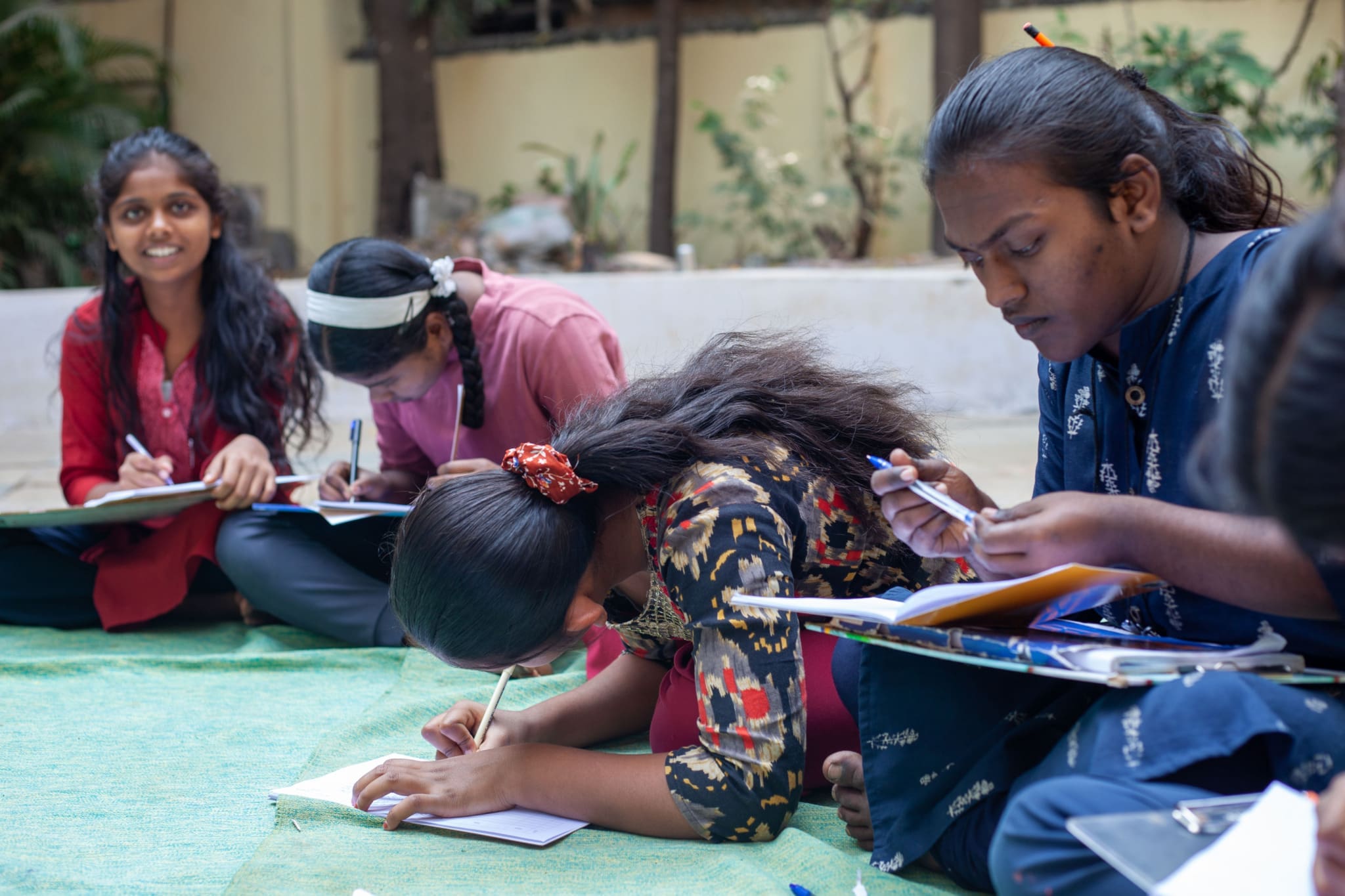
Documentation of the work ‘Unhatanhat no more, no longer Upashitapashi’ by Rajyashri Goody
This tension is not resolved and continue to shape the condition within which these works operate. The so-called “contact zone” is not a neutral meeting ground; it is structured by histories of colonisation, the circulation of capital, and persistent asymmetries that shape who is heard, who is seen, and under what terms. The patterns produced under these conditions have long carried the marks of exclusion and violence, and they have been read, decoded, and reinvented across time, and continue to reproduce themselves in different forms. What is at stake in the works of Paintsil, Afefé, and Goody is not a refusal of this history, but a proposition to shift which patterns we observe, inhabit and make. The artists work with patterns that centre attentive and sustained relations to take shape and be held in common. What is being proposed is not an alternative outside these conditions, but a way of working within them differently: insisting on forms of access, care, nourishment, and hospitality as structuring principles capable of enacting possibility, collective potential, collaboration, friendship, loving memories.
In the framing of Koyo Kouoh, artistic practice is positioned as something that works within its social conditions, opening relations, sustaining forms of attention, and composing ways of being together. The emphasis shifts away from scale as measure of significance, towards intimacy of relations and what a gesture can hold. In this sense, the works gathered here can be understood as constructions of relation, as they operate within the conditions of daily life rather than outside them, accommodating its rhythms, fragilities, and continuities. In doing so, they propose something close to what Kouoh describes as a logic of generosity and hospitality in artistic practice, structuring relation between people, materials, and worlds.
What The Message Is in the Pattern proposes is a different mode of attention. If the message is in the pattern, it is because it cannot be extracted from it. It has to be read there across repetitions, interruptions, shifts in tone and tempo. Not all at once, and not from a distance, but in proximity, and over time.
Curatorial Statement by Beatriz Lobo
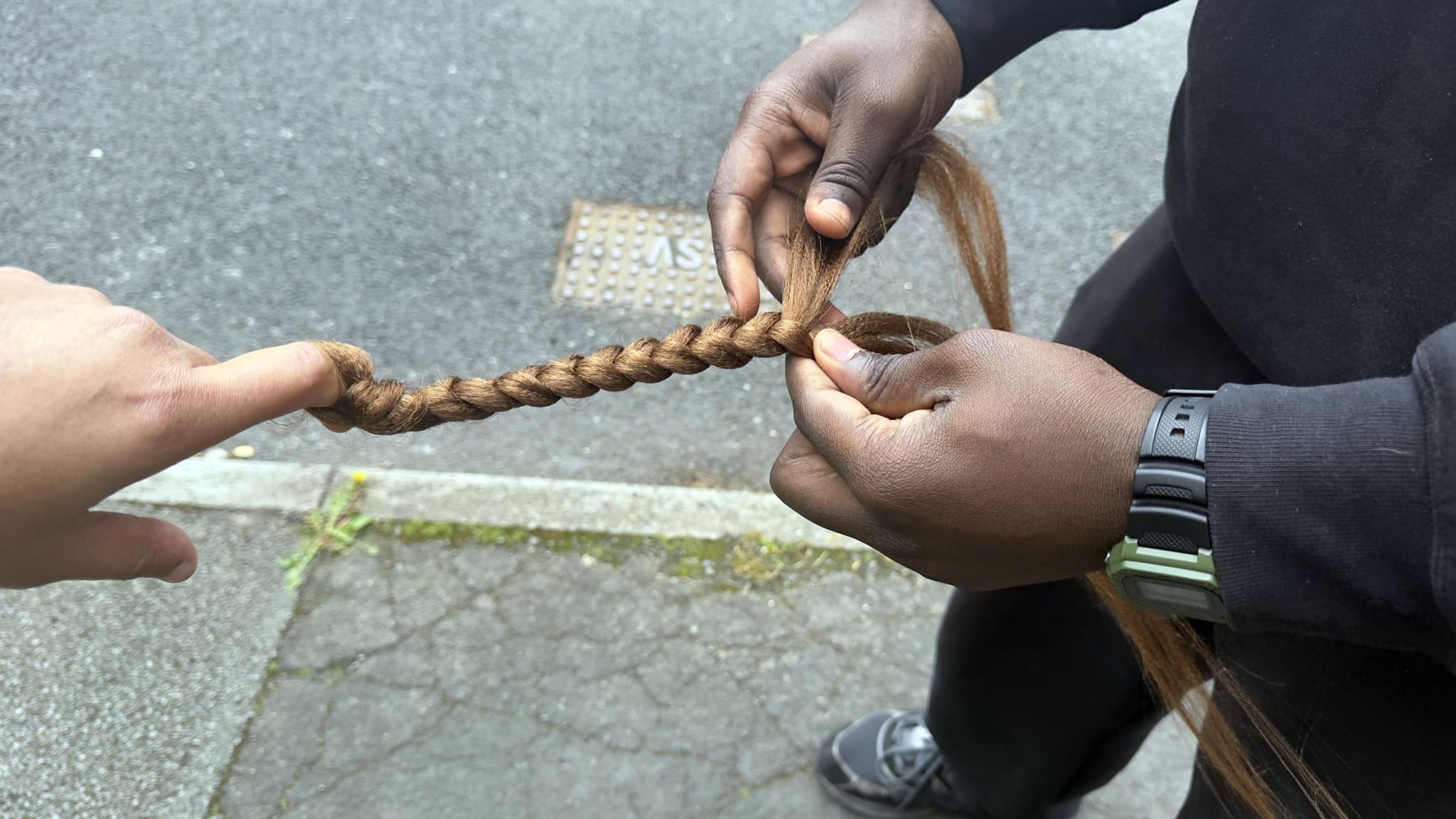
Documentation of the work ‘Spun Yarn’ by Anya Paintsil
About the Artists
Anya Paintsil
Anya Paintsil is a Welsh and Ghanaian textile artist who lives and works in London and Glyn Ceiriog. Drawing inspiration from her childhood in North Wales, and her ancestral, Fante tradition of figurative textiles, Paintsil combines craft practices she was taught as a young child; rug making, appliqué and hand embroidery with afro hairstyling techniques to create large scale portraits. Paintsils’ figures explore the possibilities and politics of non representative depictions of the Black figure.
Often mistaken as subversion of ‘primitivism’, Paintsil deliberately and consciously refuses to root her work in the European Fine Art Canon, Paintsil’s visual language finds its basis in traditional West African Crafts and Art – carvings, wood sculptures, masks – exchanging the hard materials for soft, in an interrogation of gendered labour, particularly the labour of working class women.
Rajyashri Goody
Rajyashri Goody was born in 1990 in Pune, India. She is currently based in Goa. Goody completed her BA in Sociology at Fergusson College in Pune in 2011, and an MA in Visual Anthropology at the Granada Centre for Visual Anthropology at the University of Manchester, UK in 2013. In 2023, she completed a two year residency at the Rijksakademie Van Beeldende Kunsten, Amsterdam.
Her research interests include food and water politics, religion, literacy and literature, mobility and place-making in the context of caste-based violence and Dalit resistance in India. She works with found objects, paper pulp, clay, text, photographs, printmaking, and performance.
Goody’s work has been presented at the Serendipity Arts Festival, Goa (2025, 2019); Bukhara Biennial (2025); Sao Paulo Bienal (2025); Sharjah Biennial (2025); Busan Biennale (2024); National Museum for Women in the Arts, Washington DC (2024); Asia Now, Paris (2023); Jogja Fotografis Festival, Yogyakarta (2023); Recontres de Bamako (2023); Galleryske, New Delhi (2022); Breda Photo (2022); Savvy Contemporary, Berlin (2022); Goethe Institut, Pune and Mumbai (2025, 2021).
Rose Afefé
Rose Afefé is a visual artist from Bahia, Brazil. Working across installation, painting, and photography, her practice is rooted in the activation of memory, territory, and collective knowledge. She is the creator of Terra Afefé, an ongoing, human-scale micro-city built with earth using traditional adobe techniques and lime painting, located in the rural area of Ibicoara, in the Chapada Diamantina region. Conceived as a living artwork, Terra Afefé operates as a space of encounter and coexistence, where art and life intersect through local knowledge, nature, and shared processes.