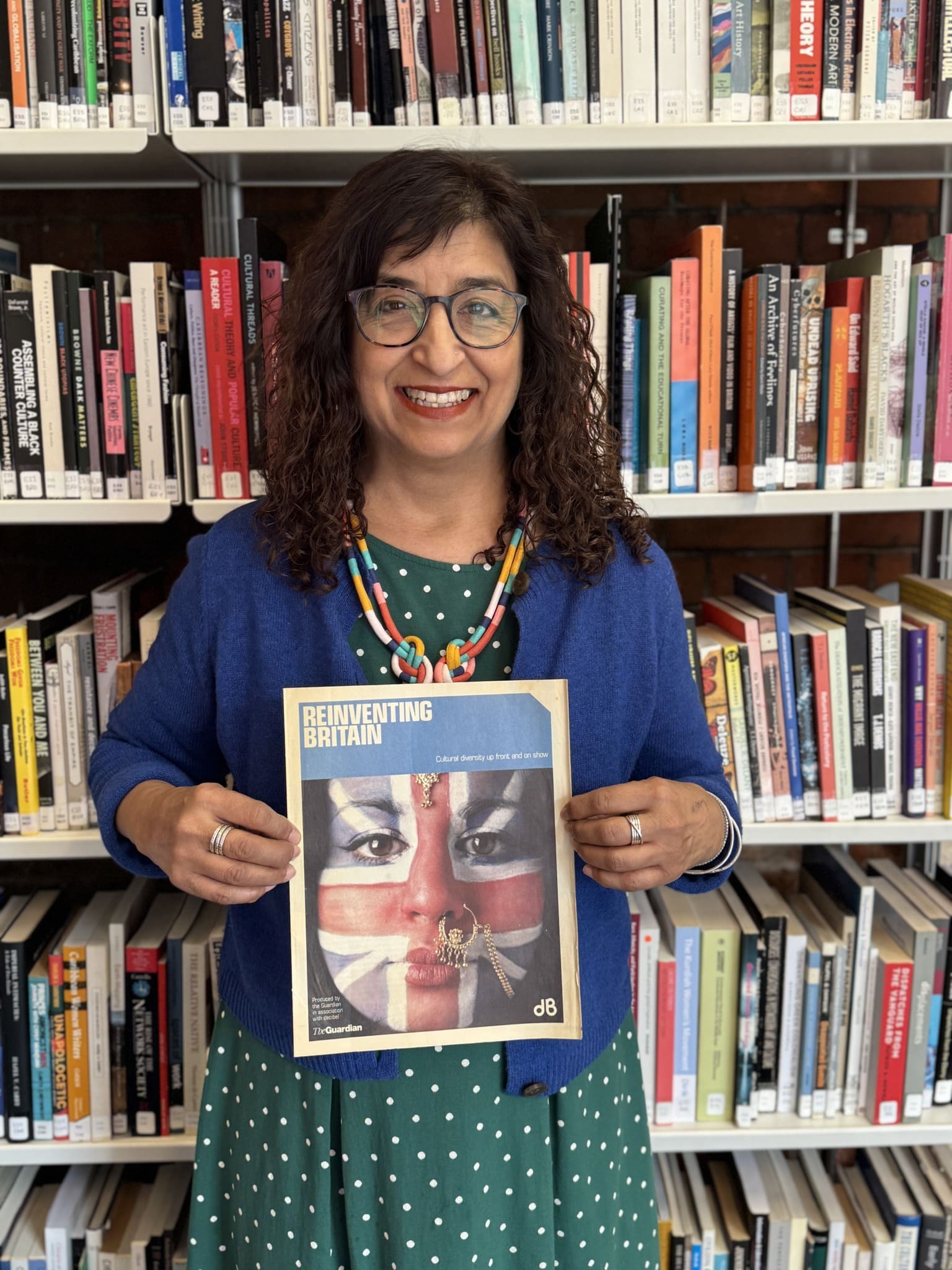
Image of Imrana Khanum in Stuart Hall Library, 2026
After twenty-eight years teaching Art in secondary schools with an MA in Museums and Education, I semi-retired to work part-time and, with the time gained, offered my services as a volunteer with the Stuart Hall library. I have always valued the work they do in centring Global Majority artists. Reading the 2024 Visualise report led me to want to write a blog about issues around belonging, identity, and inclusion in Art education. Identity is about belonging, about what you have in common with others and what differentiates you from them. It gives you a sense of personal location, the stable core to your individuality. I hope my blog offers support to Art educators in introducing Global Majority artists to their students.
Why Belonging Matters
The theme of belonging and identity has been important throughout my life as I was born in Mombasa, East Africa, to parents from the Punjab, India, and migrated to the UK in 1971. They migrated across two continents that were previously part of the British Empire due to changes in the political climate. Having never visited my parents’ hometown, as it is now part of India after the 1947 Partition, I have often wrestled with the notion of ‘Belonging’. This is a thread that can often run through the Asian and Black diaspora living in the UK from former British colonies.
As an art educator, it has been a concern to decolonise the curriculum in order to acknowledge Asian and Black diasporic experiences. Voices that were often missing from my own education in the 1970s. Rooted in the issue of belonging, my pedagogy is one of multicultural education. It addresses cultural and social issues that individual pupils might experience, while also encouraging the appreciation of the histories, cultures, and achievements of a wide range of ethnic groups.
Evidence from Research
It also involves the development of individual and social relations based on pluralism and tolerance, Dave Allen’s statement, “Art teachers must expand on the knowledge of Art, of secondary school children, from their current misconception that Art was done by a bunch of men in Paris in the early nineteenth century” (Allen, 24/04/1996, PGCE Lecture at Institute of Education, London), echoes my own concerns about Art education in secondary schools. He, like myself, recognises the need to address the multi-racial and gender issues in Art education to create an environment of equal opportunities.
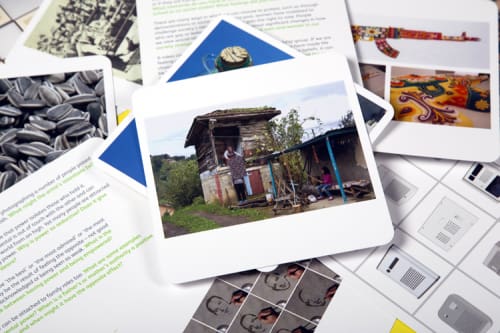
Emotional Learning Cards. © Christa Holka 2014
Over my many years as an inner-city London art teacher, I have seen an increase in the number of students from different cultural backgrounds. The majority are from former British colonies, or those seeking refuge from war-torn countries, and increasingly from Eastern Europe. To address a growing multicultural community, schools should develop a pupil-centred approach by including their individual experiences, needs, and thought processes within their artwork. We need to encourage a multi-ethnic focus as well as a wider sense of social and personal allegiance.
But you may ask the question: Is multicultural education a concern for all schools, regardless of the culture of their pupils or their local community? If we educate pupils to see the world through the lens and values of cultures different from their own, we may instil a wider sense of social and personal allegiance to the wider community in the UK. Multiculturalism is a strength for all schools regardless of their local community. Through a diverse curriculum, pupils can be uniquely challenged in clarifying their sense of self-worth and future plans.
Leon Wainwright wrote in Art and Multiculturalism (1988): “The dominant attitude in this country towards ethnic minority arts may be described as ‘cultural imperialism’: the belief, not that ‘our culture is best’ but ‘ours is the only culture’. Non-white children are quick to pick up on the implication that their entire ancestry has added nothing of value to the sum of Human Knowledge. Immediate steps have to be taken to give minority groups a positive self-image, and we have to provide a more positive image of the many advantages this country has acquired in becoming multi-racial.”
Personal aspirations and self-worth were lacking for my Bengali A-level Art students at an East End school in London, and they confided in me about feeling unconfident about entering the art world. This was due to a lack of role models to aspire to, as they had not been made aware of any. I remedied this immediately with examples of successful musicians, architects, writers, artists, and creatives from South Asian backgrounds. I admitted that I had also felt the same, but persevered and developed a career in the Arts, although in the 1980’s I was one of only two students of colour on my BA course at St Martin’s School of Art.
What Needs to Change
There are always questions to be asked about the terms on which a dominant culture celebrates or denies another culture, ridicules or appropriates it. To what extent does an erstwhile marginalised body of work merely fulfil the market’s relentless braying for novelty? To what extent will it be abstracted and severed from context? How long can it stay out of the cosy exotic pocket permitted by an art world that now sanctions certain, selective forms of pluralism? Mainstream future fails to recognize the complexity of Black artists’ cultural positioning. As a result, they are only partially visible in mainstream galleries and, therefore, rarely make their way into the curriculum.
Until Black and Asian artists are no longer reduced to their race alone, their equality, and by extension, their visibility, will be out of reach. In turn, this will continue to create an imbalance in visual resources and exhibitions available, which are inclusive and culturally diverse. Teachers will continue to struggle to challenge popular assumptions of stereotypes, address pluralism, and deliver a historically unbiased multicultural education.
The Runnymede Trust and Freelands Foundation worked together on a ground-breaking partnership to deliver the first major research commission into visual arts access for Black, Asian, and ethnically diverse students in the UK. The initiative aimed to catalyse long-term structural change in a sector where only 2.7% of the workforce are from a Black, Asian, or ethnically diverse background.
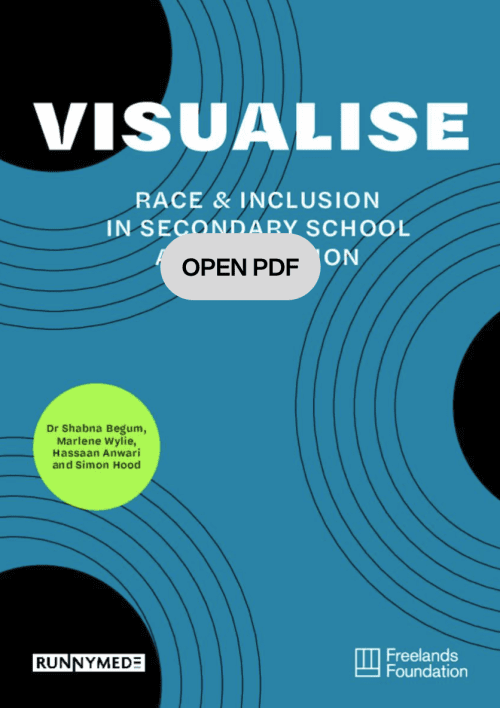
Front cover of Visualise report from Freelands Foundation
The 2024 Visualise: Race and Inclusion in Art Education report by the Runnymede Trust research found that only 2.3% of artists referenced in GCSE Art exam papers are from Black or South Asian backgrounds. As well as calling for diversification of the curriculum, the report also calls for greater diversity and representation in examination papers, and in the workplace more broadly. This new research reflected a strong desire amongst teachers and students to diversify teaching content and improve experiences of art education for all. Despite the desire, teachers are constantly under pressure, overworked and under-resourced, and art education in schools remains overwhelmingly narrow in terms of curriculum content and exam assessment.
The DFE should support our teachers and schools by diversifying the National Curriculum and Exam boards. The school curriculum should be an encouragement for children to value themselves, their world, and its people. By including a larger number of Black and Asian artists, we can create a greater sense of belonging through representation, an understanding of our positioning as the non-Western global majority, and the appreciation of our irrevocably intertwining and interdependent environment. This humanitarian modality is what multiculturalism is about.
As part of the remit for gaining funding, museums and galleries’ educational programs would be required to be more inclusive.
The Visualise report by the Runnymede Trust has found that art exam boards have done considerable work in the space of a year to interrogate their exam materials. Representation of Black artists has increased from 1.8% to 8.7% of all artists referenced. However, South Asian representation has only increased from 1.2% to 2.5%. It further recommends that the Curriculum and Assessment Review Commission make an explicit recommendation that inclusive materials are compulsory.
Consequently, the Curriculum and Assessment Review’s ‘Building a world-class curriculum for all: Final report’, published in November 2025, recommends this principle:” The national curriculum is for all our children and young people. As such, it should reflect our diverse society and the contributions of people of all backgrounds to our knowledge and culture.”
Resources for Teachers
Across London, there are many organisations and resources that centre and support our diverse society. To help teachers, here are my recommendations on finding multicultural resources to incorporate into their own pedagogical practices and curriculum:
In 2024, Oak National Academy reviewed its online Art teacher’s resources with an initiative to improve diversity, with the artists included. This has been addressed consequently in 2025.
You can visit organisations which represent and archive a diverse range of artists’ work from the global majority, such as Stuart Hall Library (Iniva), Museum X, ACAVA, Africa Centre, the 198, Autograph, October, plus Tate Modern Gallery.
Specifically, the Tate also offers TateShots, which is a free videocast programme on a variety of artists, as well as teaching resources that have a good selection of Global Majority artists. Both are available on Tate’s website.
Recommended reading on the theme of Belonging is:
- The 2024 Visualise: Race and Inclusion in Art Education report by the Runnymede Trust research
- Visualise one year on, report by the Runnymede trust, 2025
- The Curriculum and Assessment Review – Building a world-class curriculum for all, Final report, November 2025
- Marland, 1987, Multicultural Britain, the Educational Challenge
- Channel 4 series ‘Full English’ Grayson Perry, 2023
- Lyn French, Stories Told and Untold, 5th June 2024, Iniva blog
- Arts Education for a Multicultural Society: An evaluation of the AEMS project, edited by John Eggleston, published by Trentham Books, 1995. (Stuart Hall Library, ESS ART)
- Decolonising the arts curriculum : perspectives on higher education / collated and curated by Hansika Jethnani, Lucy Panesar and Rahul Patel, published by University of Arts, London, 2018. (Stuart Hall Library, ZIN DEC (1))
- Identity and culture: narratives of difference and belonging by Chris Weedon, published by Open University Press, 2004.
To support art teachers in being inclusive and addressing issues around identity and belonging for their students, I chose to build a reading list around Portraiture, as it is a rich area for creative self-expression.
Self-portraits can reveal many aspects of an artist’s personal and cultural life, with some exploring issues around belonging. A wide range of artists of different genders and races can be referenced at the Stuart Hall library.
I remember drawing a series of self-portraits from observation for my GCSE in Art myself. I still have them as they captured how I was feeling at the time – someone unsure of their identity as it was changing from that of my parents. I was growing up in Britain and assimilating with British culture, which was influenced by my peers, television, fashion trends, plus listening to music. I felt I was Asian but also British.
This cross-pollination was very evident when I first visited Rawalpindi, Pakistan, in the 1980’s as a young woman. A group of local young men jeered at my sister and me, shouting, ‘Look at those aliens from outer space.’ To them, we did not fit the norm of a Pakistani woman, although we were respectfully dressed with a chunni – scarf over our shoulders. They said it was because of the way we walked, talked, and dressed differently. Not opting for a shalwar kamiz but a long kurta- tunic and trousers. This behaviour from local Pakistani men continued whilst I worked in Peshawar in northern Pakistan in the mid-1990s as a designer for a women’s sewing project. In this region, women were discouraged from going out alone, and thus, I attracted a great deal of unwanted attention, more than Western women. This experience made me confront my sense of belonging and my in-betweenness to realise that I am culturally South Asian but British and a Feminist.
The artist Chila Kumari Burman Singh created a self-portrait called ‘Stereotypes Reinforce Mystery Izzat,’ 1992. Izzat in South Asian culture is linked to the woman’s family’s respect in society. If a woman breaks with any cultural expectations, such as how she dresses, she can bring shame to her family. This expectation does not affect men to the same extent. In this self-portrait, Chila is wearing western clothing, I imagine to challenge the stereotyping of women.
Recommended resources on the theme of Portraiture are:
- Oak National Academy Art & Design teaching resources
Stuart Hall Library, Iniva, has an archive of a wide range of global majority, non-Western artists - Portraiture education pack by Rohini Malik, publisher Institute of International Visual Arts, 1995 (RP POR)
I have listed the following books at the Stuart Hall library, iniva, in categories of Black and Asian artists for equal representation of race and gender.
Black portrait artists:
- The time is always now: artists reframe the black figure by Ekow Eshun, National Portrait Gallery publications, 2024. (410.111 NPG TIM)
- Sonia Boyce. Recent work by Simone Alexander, Whitechapel Art Gallery catalogue, 1988 (AS BOY)
- Deborah E Roberts included in Black Futures / edited by Kimberly Drew + Jenna Wortham. (747 BLA)
- Lubaina Himid / edited by Michael Wellen ; with words by Lubaina Himid ; and contributions by Amrita Dhallu, Christine Eyene, Lisa Merrill, Griselda Pollock, Magda Stawarska-Beavan, Carol Tulloch. Publisher: London : Tate Publishing, 2021. (AS HIM)
- Claudette Johnson, Presence, edited by Dorothy Price, Barnaby Wright, Paul Holberton. Publishing, 2023 (AS JOH)
- Chris Ofili by Judith Nesbitt, Tate Publishing, 2010 (AS OFI)
- Kehinde Wiley, a new republic / edited by Eugenie Tsai; with an essay by Connie H. Choi, Brooklyn Museum, 2015. (AS WIL)
- Zanele Muholi: faces and phases 2006-14. Publisher: New York : The Walther Collection, 2014. (AS MUH)
- Hurvin Anderson included in The time is always now : artists reframe the black figure / Ekow Eshun. Publisher National Portrait Gallery, 2024. (410.111 NPG TIM)
- Noah Davis, edited by Wells Fray-Smith, Paola Malavassi, and Eleanor Nairne, Barbican Art Gallery, London, Prestel, 2022. (AS DAV)
- Hew Locke, what have we here?, contributors: Isabel Seligman and Indra Khanna, authors: Isabel Seligman and Indra Khanna, publisher -The British Museum Press, 2024 (AS LOC)
Asian portrait artists:
- Yun Suknam, Burning down the house : Gwangju biennale 2014 exhibition catalogue. Editor Jessica Morgan, 1968, Publisher Bologna : Damiani, 2014 (519 5 BIE)
- Chila Burman, by Emma Poulter, Tate Publishing, 2024 (AS BUR)
- Amrita Sher-Gil, a life by Yashodhara Dalmia, Publisher Penguin Viking, 2006 (AS SHE)
- Baljit Balrow, Message to India, publisher University of Derby, CASPAD, 2001 (410 MES)
- Yayoi Kusama by Laura Hoptman, with contributions from Akira Tatehata and Udo Kultermann. Published by Phaidon, 2000 (AS KUS)
- Shirin Neshat exhibition, preface by Farzeneh Milani, Barbara Gladstone Gallery, 2001 (AS NES)
- Rasheed Areen, editor, Nick Aikens, Publisher Gateshead, BALTIC Centre for Contemporary Art, 2017 (AS ARA)
- Rabindranath Tagore, a celebration of his life and work, [Place of publication not identified], Rabindranath Tagore Festival Committee, 1986 (AS TAG)
- Shanti Panchal, private myths: works on paper, publisher Pitshanger Manor Gallery, 2000 (AS PAN)
- Matthew Krishanu, Anomie Publishing, 2023 (AS KRI)
- Bhajan Hunjan. Colour dialogues by Bhajan Hunjan, Publisher Cartwright Hall, 1994 AS HUN)
- Mari Katayama by Mari Katayama. Journal: International Gallerie; v.22, no.2, Publisher Gallerie Publishers, 2019 (International Gallerie (article ; v.22, no.2)
- Sunil Gupta monograph, Publisher Autograph ABP, 1998 (AS GUP)
A self-portrait that resonates with me is by the artist Baljit Balrow, who painted a British flag on her face, and said: ‘My parents see me as Indian, but my friends see me as British. I see myself as both British and Indian.’