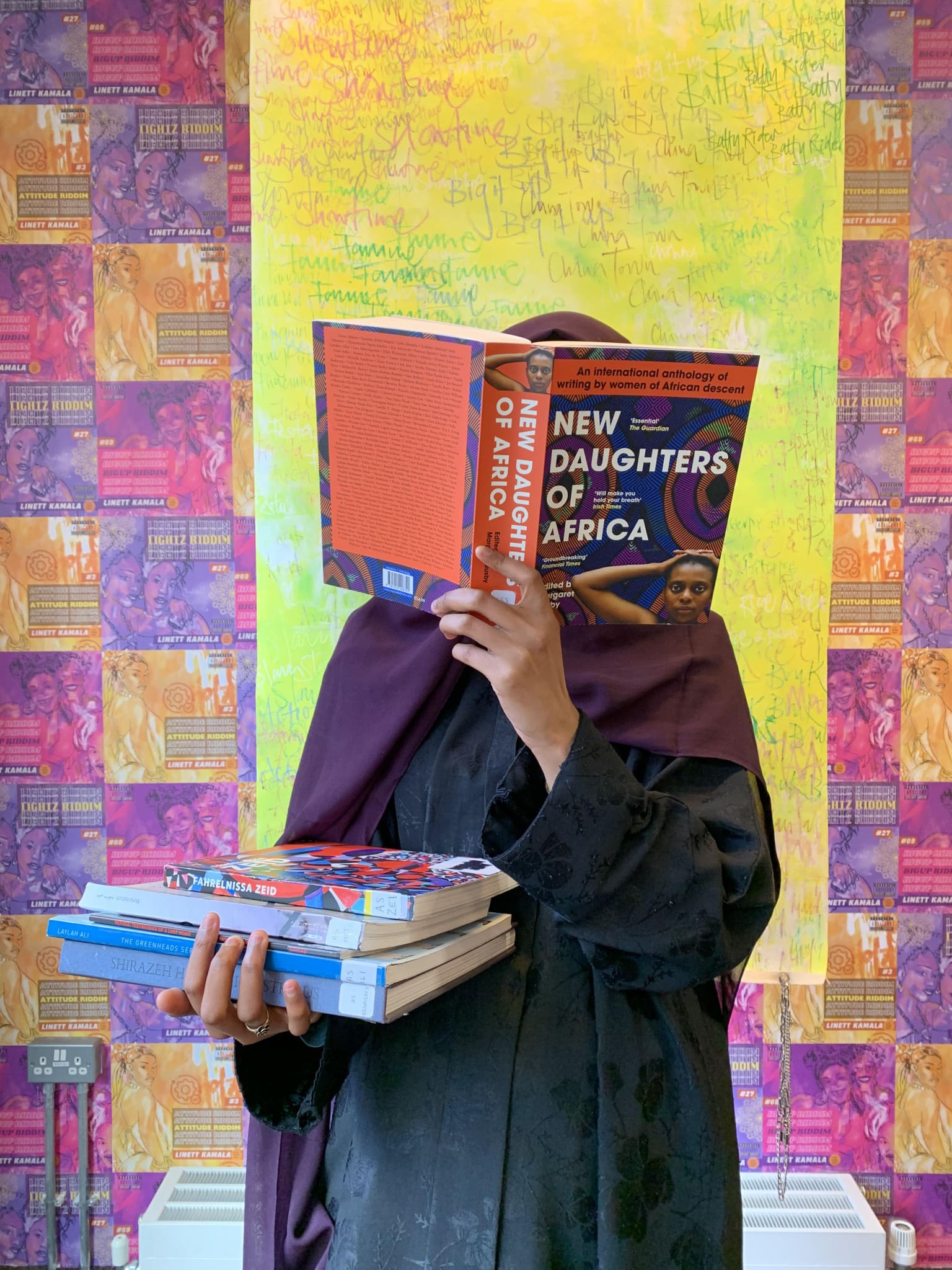
Surah ya Salaam at Stuart Hall Library
Within the Euro-American imagination, the Muslim woman artist is always looking back.
They are maternally preserving. Their art reconciles pasts of migration, pasts of colonisation, pasts of displacement, fragmentation, refugee-dom; the boats and the children who died on them; they are forever clutching together what remains of nations and families and societies. That is their allotted place. One could argue – an allotted cage.
Within this cage, eyes watch them. No woman is more visible within Euro-American anxieties than the veiled woman; the oriental other. We watch the Niqabi hovering down the high street, the woman in Jilbab clutching her children, the Muslimah praying on her shift. Within Euro-American paranoia, monsters have to be made out of them.
And the Muslim woman artist works to resist this.
But the past has to be in service to something, otherwise it is perpetual. What happens when oppression keeps Muslim women stuck in past-making, never being able to move out of place? How do they then, hyper-surveilled like this, and frozen in someone else’s meaning, dream?
They invent the future.
Because Euro-American society has cancelled the future with their global capitalism, but there is a gap where the future once sat. And it must be invented.
In fact, it is the Muslim woman tradition to invent. Who else but Fatima Al Fihriya could have invented the first university? It is within our heritage to imagine futures never before conceived, to return to the Quran, sunnah and our liberationist models. Despite the past-making, there was always an obscure but alive heritage of Muslim women artists who were, and still are, inventing the future.
Throughout the Stuart Hall Library collection, a body of these artists’ works can be found. From Palestinian multi-media artists altering thinking on space-time, an informal art school set up by a Turkish artist in Amman using God-centric principles or Egypt’s premier English-language writer reviving satire in the face of the hypocritical – they all offer necessary re-orienting orientations; women who have tilted their heads, past the watchers watching them, to look for God in the future. To steady themselves and their students and their audiences with tasawwuf, tazkiya, and inventions, to offer a path from the cycles we are caged in.
Browse through any in the reading list below to help you unravel.
Mona Hatoum, with text by Andrew Renton. Published by Jay Jopling/White Cube (London), 2006. [AS HAT]
Mona Hatoum’s monograph brings together decades of work using geometry and materials such as glass and steel to examine form and formlessness. There is a comment next to her ‘maps’ installation: ‘Maps are produced because the home of the past is gone.’ With this, Hatoum challenges the infrastructure of memory in her art, and through the perspective of her Palestinian roots. She reorients us with bold visual pieces to communicate that we must make our cartographies for the future now. Edward Said wrote of Mona Hatoum’s work that it is ‘hard to bear’ and her work around maps, and subsequently the space-time of liberation, captures the necessity of this.
Laylah Ali, with interview by curator Deborah Rothschild. Published by Williams College Museum of Art (Williamstown), 2012. [AS ALI]
“Everything I make is about the disconnect between bodies and freedom.” – Laylah Ali, 2019.
Laylah Ali’s monograph of her Greenheads series depicts small bulbous-headed green figures frozen in violent or aggressive scenarios. These illustrations made between 1996 and 2005 consist of over 80 works. The Greenheads are reminiscent of western media depictions of Muslims, but Ali’s choice to subvert colour, in making everyone green, disrupts the viewer. Without our racial narratives, we cannot tell who is the villain and who is the hero. Suddenly, we have an alternate view on violence born from the standpoint of the alien. In this, Ali’s art is unique and humorous and shows us how the figurative and speculative can imagine alternatives to the usual stories.
Fahrelnissa Zeid, with text by Kerryn Greenberg. Published by Tate Publishing, London (2017) [AS ZEI]
Fahrelnissa Zeid’s monograph is split across the two bodies of work she produced in her life: her early years and her later years. As one of the first formally trained women artists in Turkiye, she left Europe and settled in Jordan in 1975 and began to challenge the formal European training she had been given. She set up an informal art school for women, moving away from European pedagogical practices, and utilised introspection as key methodology, echoing the islamic orientation of tasawwuf. Zeid reinvented the university, as is the Muslim woman tradition, with her reform teaching and with this futurist dreaming, created an expanded style for herself and a burgeoning class of Muslim artists.
Nawaal El Saadawi – New Daughters Of Africa : An International Anthology of Writing by Women of African descent, edited by Margaret Busby. Published by Myriad Editions (Hove), 2019. ‘About me in Africa – Politics and Religion in my Childhood’, p.g. 42 [ESS NEW]
Nawaal El Saadawi’s essay in Margeret Busby’s New Daughters of Africa considers the death of the future through her experiences of education and state-sanctioned indoctrination. Throughout her career, but particularly in this essay, Saadawi is satirical in her writing, questioning the fallacy at the heart of the Muslim nation-state, and wonders aloud, how on earth was I supposed to tell the difference between the all-powerful all-seeing leader and God? Saadawi’s writing is clearsighted with her aim to break open imagination because when the future is killed, Saadawi writes, ‘Imagination was inseparable from reality’.
Shirazeh Houshiary – Isthmus, with interview by Stella Santacatterina. Published by British Council (London), 1995. [AS HOU]
“I set out to capture my breath, [to] find the essence of my own existence, transcending name, nationality, cultures.” — Shirazeh Houshiary, 2000
Shirazeh Houshiary’s monograph Isthmus was published in 1995 and captures her body of work examining transitions and the Ghaib. Her sculptures capture the importance of the interior in islam, with references to Rumi’s poems and Islamic cosmologies, and a rebuking of Western orientations. An example, referenced in Isthmus, was from 1993 when Houshiary was asked to decorate the Tate Christmas Tree. She subverted expectations, instead turning the tree upside down. She then cleaned, polished and gilded the roots of the tree – rejecting Western consumerism to return something of the sacred back to the Christmas tree.
Yasmin Yaqub – Refuge: Testimonies Of A Lost Home, edited by Fareda Khan and Alnoor Mitha. Published by Shisha (Manchester), 2006. [AS YAQ]
Yasmin Yaqub’s Refuge: Testimonials of a Lost Home is a monograph of her first major solo exhibition in 2006 in Gallery Oldham located in Manchester. Yaqub’s work uses digital media to splice pictures of asylum seekers floating in the air in parks, over bus stops and on highways that clash, and in doing this, produce something fantastical. In her reworking of space and orientation of figures on the page, Yaqub comments on the idea that a future for refugees does not exist because they are suspended in a constant now, so she makes that suspension obvious with her art, and offers us all a subverted future through this.