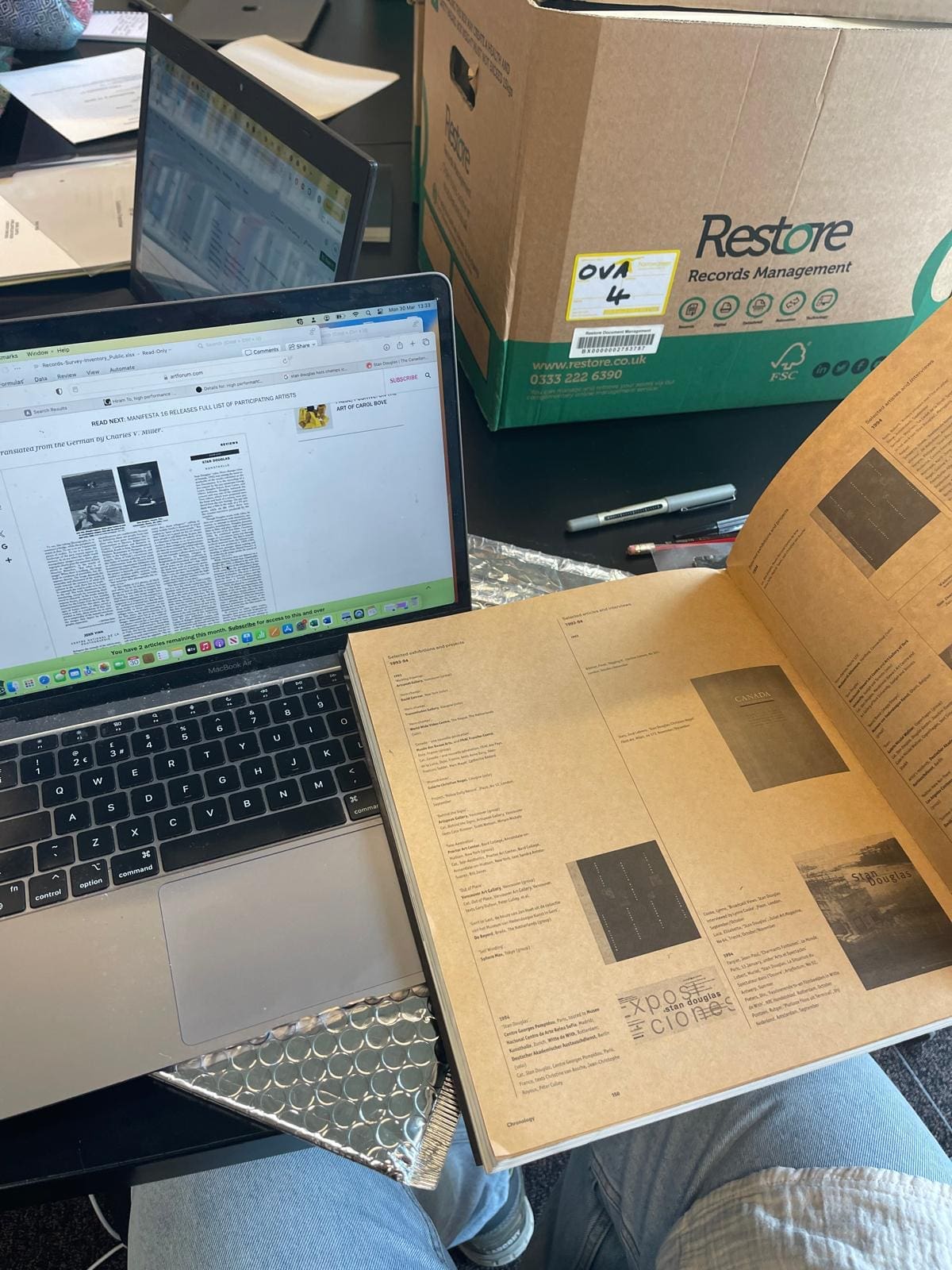
Researching into the OVA Collection at Stuart Hall Library, taken by Sepake Angiama
Have you ever looked at the word ‘return’? I mean, really looked at it. When you break it down, the word turn already hints at a movement, and then the prefix in front of the word means that there is a shift in the position, a repositioning or a turning that would mean that the direction would reorientate ‘back’ or ‘again’. When we think of returning, we understand it as coming back to the place or a position from which you have started. Like pressing the return button on your keyboard, you go back to the beginning – but not quite back to the same place, but to a slightly different or altered position.
There have been many projects of return, whether the idea that you can return people, return to ideas or the return of objects to a place of origin. We see a return to right-wing politics that has given rise to warring atrocities around the world. At what point could we see an end to extractivist wars that are built on imperial and colonial legacies? When can we begin to consider returning, repairing, restoring and rebuilding as strategies of hope? Famously Jamaican political activist Marcus Garvey promoted the Black Star Line as part of a ‘back to Africa’ movement of the early 1900s. This has been one of many projects of return motivated by early pan-African thinkers. In a process of decolonising the museum, we have seen the return of many art objects taken from the Royal City of Benin as part of the unlawful punitive expedition of 1897. The rights of return are not always fully acknowledged as we see the consistent right to refusal by many cultural institutions, including the British Museum. The campaign of returning is one of displacement, that something or someone is out of place and therefore needs to be returned to a place or position. The idea that the violence of being uprooted or extracted in the first place leaves a void that cannot be easily replaced, and that the only way to restore is to return. Many artists have worked with notions of return within their practice, and this is just one of the lines of artistic enquiry we look forward to thinking with in the coming years.
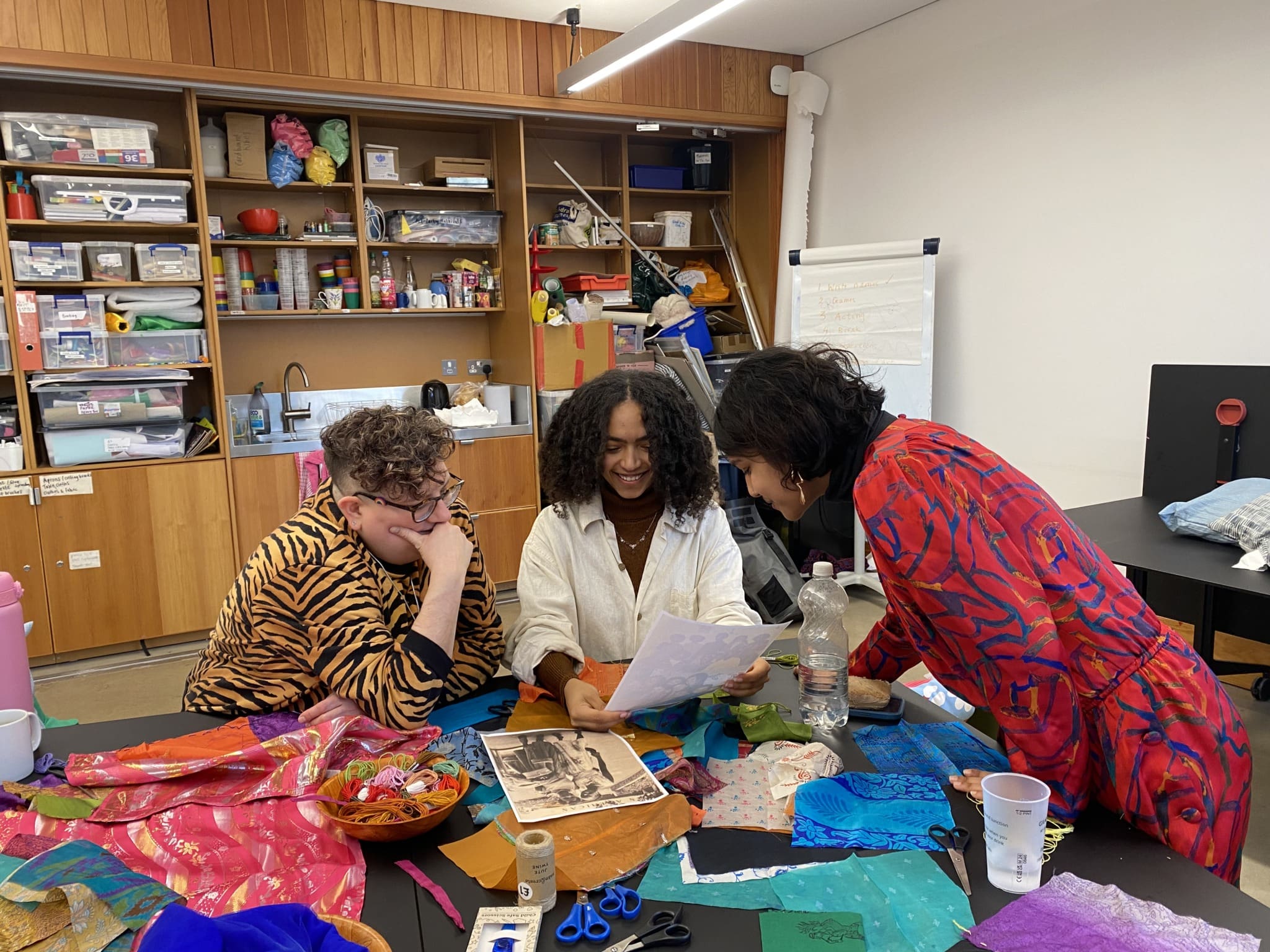
‘Fruitings Will Come’ Worskhop from Present Land Project. Photograph by Vasita Jirathiyut
After taking a break from my position as Artistic Director what I have noted is that it is not possible to simply return to the place where you left. Even after a short period away from iniva, the organisation is not the same place that I left, and neither am I. Over the last six months, so much has happened at iniva, artist Mymana Arefin supported by Pleng Jirathiyut & Climate Reframe embedded herself within Westminster communities for Present Land and produced a beautiful resource, Fruitings Will Come. The library and archive team embarked on a programme to catalogue our moving image collection and created a series of events in partnership with other cultural organisations.
This month Keith Piper and Gary Stewart revisit Club Mix, a digital multi-media presentation that originally toured in clubs in Nottingham, Birmingham and London in the late 90s. The artists will be in conversation with Daniel Oduntun at Reference Point. Dub as a research framework inspires us this month with an exhibition of the work of first female DJ at Notting Hill Carnival, Linett Kamala. Her practice brings us back to the 90s and gives the floor to Dancehall Queens whose presence on the dancefloor and as part of the culture are often overlooked. A return to 90s riddims that moved our bodies, to bop our heads, tap our hands on the dashboard, to whine the waist and pump our fists in the air.
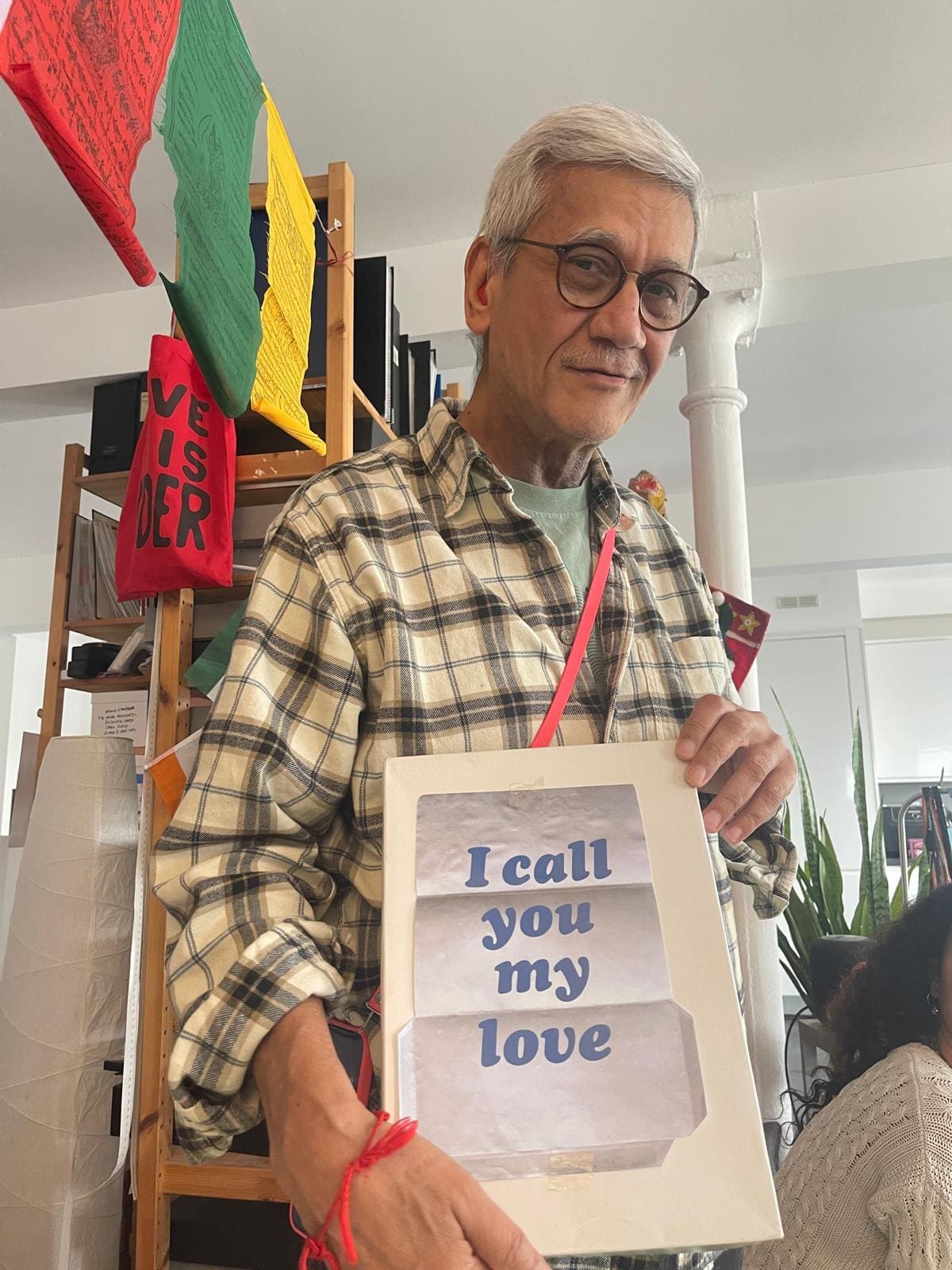
Sunil Gupta at his studio, photo taken by Sepake Angiama.
Perhaps this is what Stuart Hall meant when he said, ‘migration is a one-way ticket.’ The places that we leave may remain fixed in our memories and our minds, but places and spaces transform over time and are shaped and redefined by the encounters of others. Black music and sound system culture transformed Britain’s sensibility to music and in opening of V&A East Musuem’s inaugural multi-sensory exhibition, The Music is Black: A British Story. Children of the global diaspora might recognise that the intangible heritage our parents carry with them is a process of cultural fossilisation as described by Aras Tesfa.
Returning, offers the opportunity of a fresh perspective on the work that we do at iniva. With a renewed sense of purpose, we embark on a four year project Living Legacies: Collaboration, Community and Radicality that gives us the time and resources to fully catalogue our archive and make it digitally and physically accessible through a renewed website, digital catalogue as well as strengthening our staff and expanding our programmes towards engaging with the hyperlocal communities of Southwark, Lambeth & Westminster. Returning to the work that iniva embarked on through its exhibitions and ambition as a non-Eurocentric institution, we begin by looking at the pre-story of iniva – the donated archive of OVA – Organisation of Visual Arts led by photographer Sunil Gupta. We have been researching the projects that were mounted in the 90s and early 2000s, as well as the unrealised projects that held so much potential and promise—holding photographic slides up to the light to see incredible images of works proposed by artists to Sunil, who had a very intuitive approach to the organising of exhibitions. His research folders also included articles of the socio-political climate of the times. We are looking forward to sharing material with you as we delve into the archive boxes.
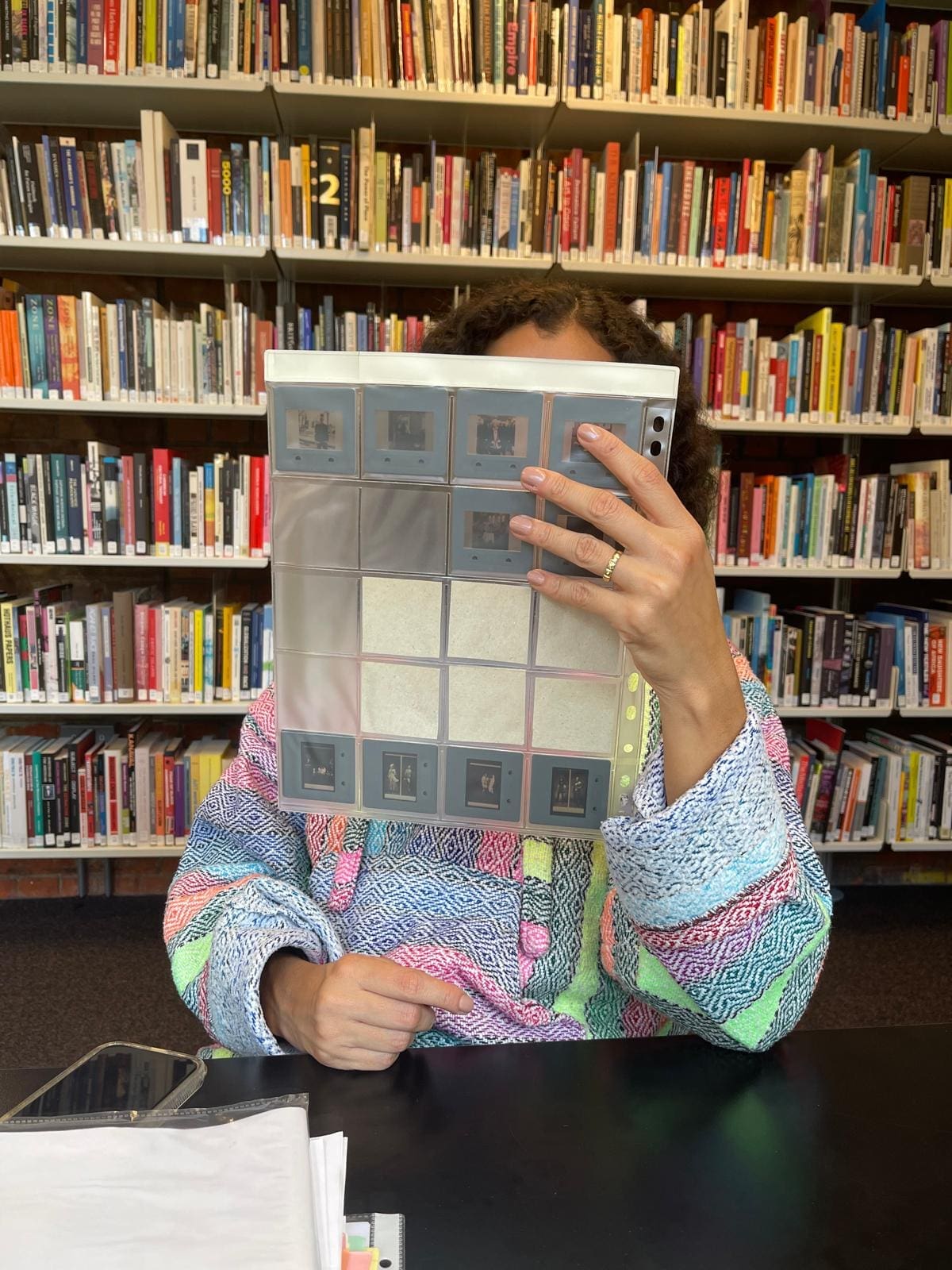
iniva’s Curator, Beatriz Lobo looking at slides from the OVA collection. Taken by Sepake Angiama.
Our final note is that we are returning to Venice this year for a third edition of the Post-National Digital Pavilion, in collaboration with the British Council at the 61st Venice Biennale. Titled The Message Is in the Pattern, the programme brings together the work of three artists, Anya Paintsil (UK), Rajyashri Goody (India), and Rose Afefé (Brazil) who are supported to work within their local contexts, exploring the intersection of community engagement, cultural translation, and the relationship between artistic and social practice. If you plan to be there on the opening days, we look forward to seeing you in Venice.
If you are interested in becoming a friend of iniva, and you like the work that we do, don’t be shy to approach us. We are happy to accept donations to support our work and your return on investment gives more artists and communities to engage through our programmes.
Sepake Angiama
Artistic Director at iniva