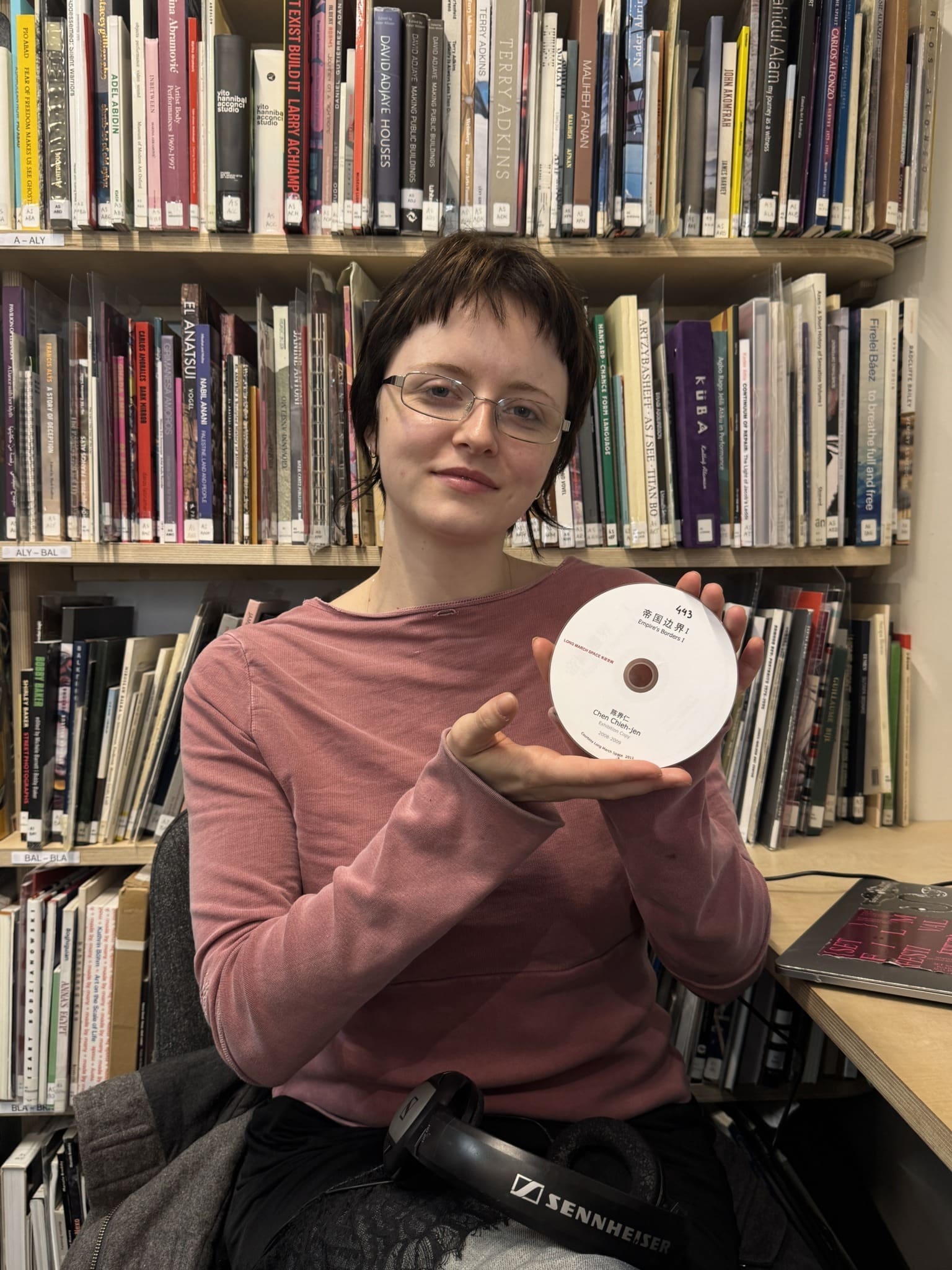
Maddie Black volunteering with iniva’s Archive.
Our archive volunteer Maddie Black reflects on working with iniva’s Moving Image Collection.
Feeling a bit estranged from art and literature while working in hospitality last year, I decided to start volunteering at iniva to rekindle lost affections. I was assigned the role of cataloguing volunteer by archivist Kaitlene Koranteng, and set on the task of watching every DVD, CD and VHS in their Moving Image Collection.
True, the repetitiveness of archival labour isn’t glamorous. But you still feel like you are seeing behind the curtain. At the very least, you are experiencing the archive in an unusual way: in alphabetical order, onboarding it piece-by-piece into the digital realm. An archive is more than the sum of its parts, as I quickly found out. Continuities began to shimmer. Relationships between the different works formed a larger web. And as I slowly progressed through each cardboard box, one conviction rose especially strong. How visual storytelling can demystify complex ideas about power and exploitation. When words like ‘systemic’ are used, it can be hard to visualise what really happened. Sometimes, you need to be shown.
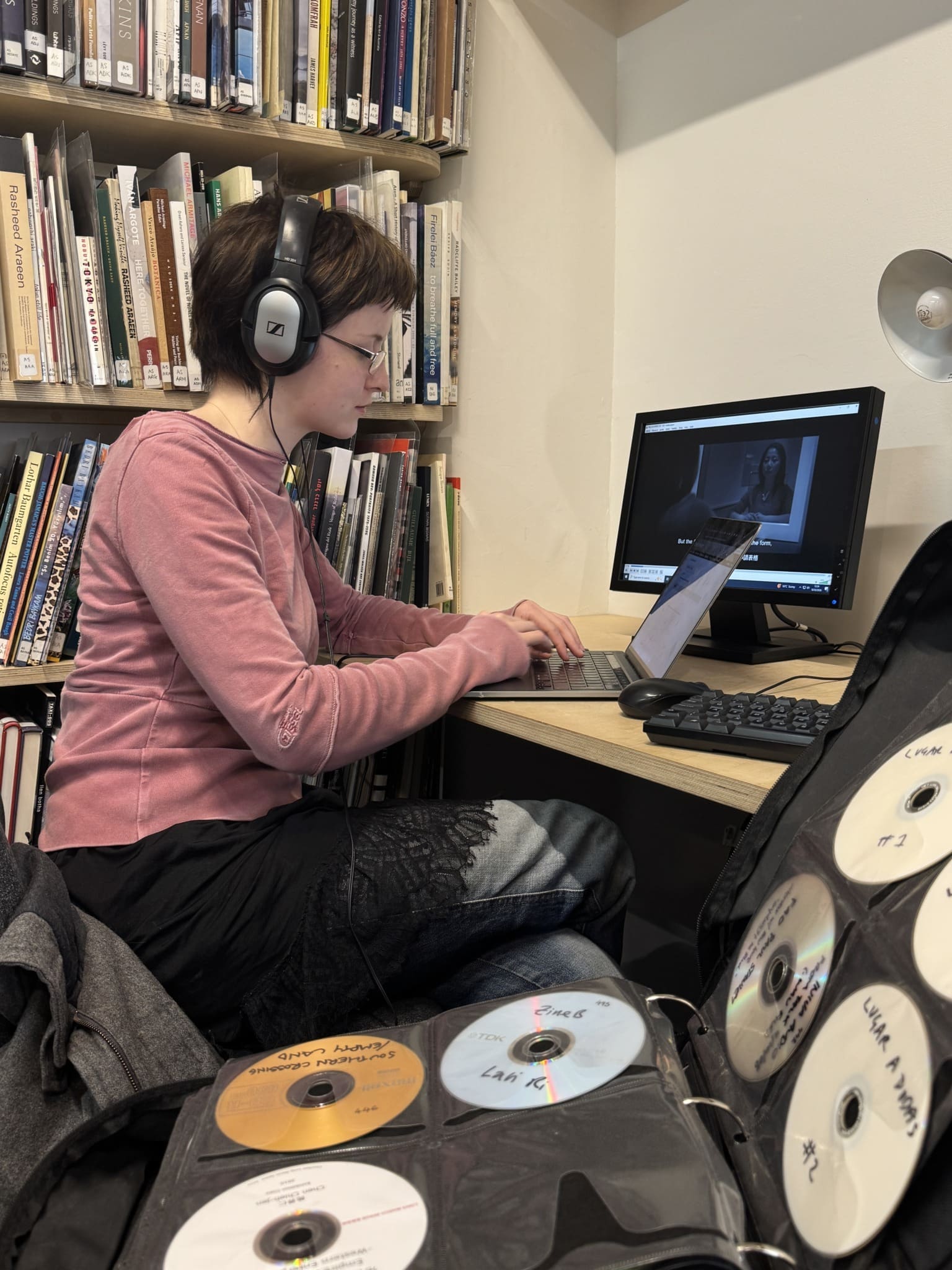
Maddie Black volunteering with iniva’s Archive.
But if you visited the Stuart Hall Library off-the-cuff, you probably wouldn’t start with the Moving Image Collection. You can’t leaf through short films like you can with books, in this case, the collection of artist monographs and exhibition catalogues. So here are some examples of the kind of moving image work housed by iniva that I encountered as a volunteer. Anyone reading might get a better idea of what’s in store – under the pollarded plane trees on John Islip Street, tucked into the Chelsea campus.
Empire’s Borders 1
This two part film by Chen Chien Jieh tells a story of a neocolonial relationship between the US, Taiwan and Mainland China crystallised in patterns of human exchange at the border. Taiwanese artist Chen Chien Jieh decided to make this film after his non-immigrant visa application to visit the US was denied. At the time of this film (2008), US citizens moved freely to and from Taiwan without a visa. Meanwhile citizens of Taiwan experience countless instance of discrimination in the process of applying for a visa to go the US. The film presents narrative accounts of this.
Taiwanese citizens recount their experience of being abused and interrogated at the border by consular officers, before having their visa applications denied for ‘unknown reasons’. This pattern of abuse cannot be reconciled by a plea by someone trying to visit a dying relative, let alone go on holiday. All of the narrators had their applications denied, often having the accusation thrown at them that they intend to stay in the US illegally – an accusation with no basis. The video is set in a reconstructed set of the immigration offices and the American Institute of Taiwan. This set effectively underlines the way that bureaucracy clouds violent realities, in this case, a dominant state disciplining the citizens of a subordinate state by restricting their movement with impunity.
A Common History
This short documentary about race and class in Leicester explores what it was like to arrive in Britain and be part of an industrial workforce as a non-white immigrant in the 1950s. This was the case for many South Asian emigrants following the Ugandan expulsion. In A Common History interviews with Leicester residents and factory workers piece together a picture of the intersection of class struggle and racism. Contributors explain how white factory workers routinely excluded their immigrant coworkers in the the unions and the pubs. White workers crossed the picket line while their black and brown counterparts were on strike. The documentary traces these increasing racial tensions which culminated in the Imperial Typewriters Dispute in 1974, one of the most significant industrial strikes by migrant workers. The dispute saw 500 workers largely from South Asia go on strike over discrimination. Though conditions for these strikers did not necessarily improve, and many suffered unemployment as a result, the dispute remains a landmark event of solidarity among South Asian workers in Britain. It is also remembered in union histories as a particularly pernicious instance of divide-andrule tactics by factory employers to corrode solidarity across racial lines. The title of this film ‘A Common History’ nods to that legacy.
A Crime Against Art: A Mock Trial
This film by Hila Peg presents a mock trial in a televisual docudrama format with all the usual characters: the prosecution, the defendants, the judge and the jury. The central question of this trial is about the state of art within a new global art market dominated by the new bourgeoisie. Has a crime against art been committed? Meaning, broadly, have artists lost their agency to make and distribute art properly in these new and constraining conditions? One by one, different characters assess the situation and sketch out the art world as deeply imbricated as much in capital
as creative practice.
A highlight of this theatrical and energetic debate is when the artist Setareh Shahbazi takes the stand. She is the only artist witness. So, in a way, the person around which the whole debate hinges. But Shahbazi attests that she finds the whole trial and its vocabulary alienating and elitist. She says the debate is not one she feels she can meaningfully participate in. She describes the features of her exclusion as an artist from universities and art fairs, and points out that the demographic of those institutions is the same one inhabiting the courtroom she stands in presently. The artist’s boldly honest testimony disarms the mock artifice and intellectual showmanship that the rest of the room appear to be playing into. As Shahbazi calmly unveils the hypocrisy of the whole undertaking, the prosecutor says in response: ‘we might actually be enforcing conventions that in themselves
are guilty’.